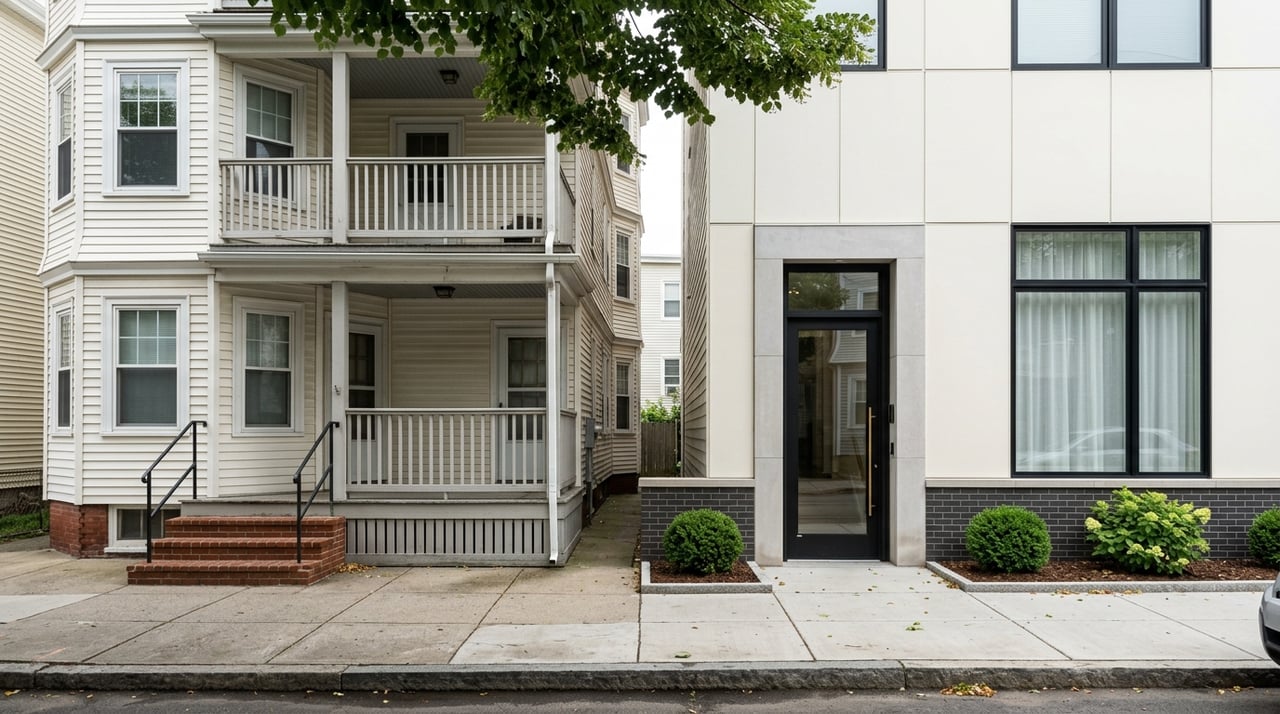
Buying your first place in East Boston can feel surprisingly tricky when the choices look closer on paper than you expected. A newer condo and a classic triple-decker flat may sit in a similar price range, yet the day-to-day ownership experience can be very different. If you are trying to figure out which option fits your budget, lifestyle, and renovation comfort level, this guide will help you compare the tradeoffs with more clarity. Let’s dive in.
East Boston first-buyer reality
East Boston is still hovering around the high-$600,000 range in spring 2026. Recent market snapshots show median sale and listing prices around $684,000, with homes taking roughly 74 days on market on one dataset and 122 homes for sale on another. The big takeaway is simple: for many first-time buyers, the question is not whether a condo is cheaper than a flat in a dramatic way, but which option creates the better monthly and long-term fit.
That matters because list price is only part of the equation. In East Boston, many buyers are comparing homes that overlap in size, even when one is a newer development and the other is part of an older building. Once prices get close, condo fees, repair risk, parking, and move-in readiness start to matter just as much as square footage.
Newer condos in East Boston
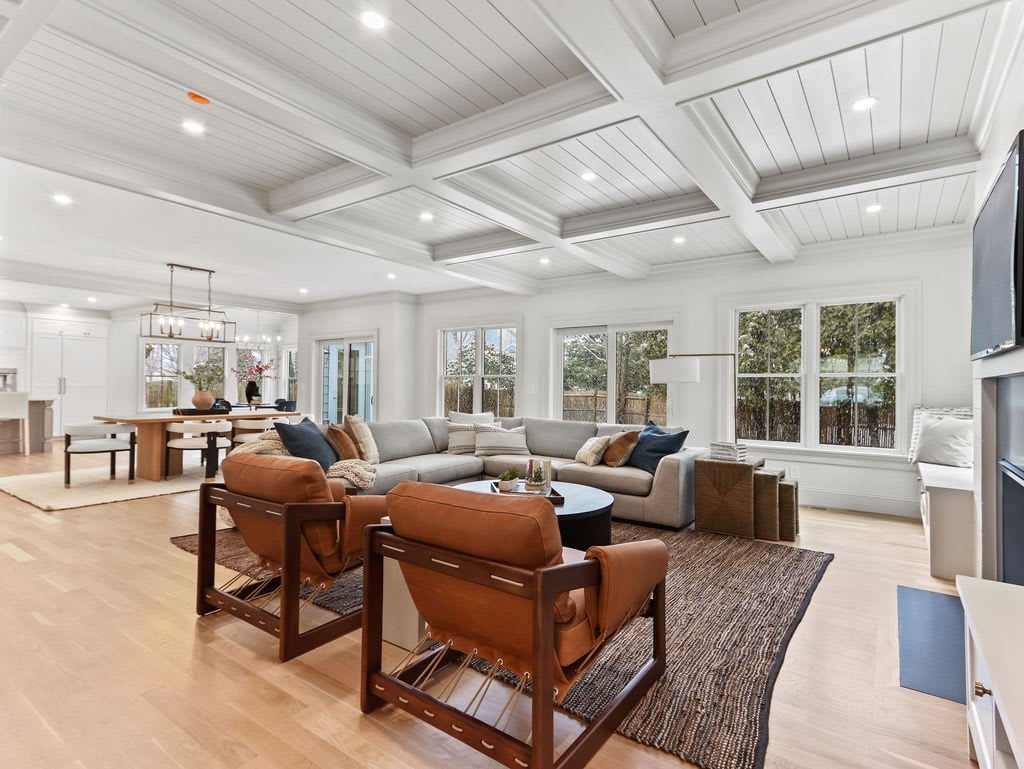
Newer East Boston condos tend to appeal to buyers who want a more predictable move-in. Current examples in the neighborhood feature open layouts, in-unit laundry, private outdoor space, and parking, with HOA fees in the low-to-mid hundreds per month in the sampled listings. For a first buyer, that can feel more manageable because fewer immediate projects are competing for your cash.
At projects like 246 Havre, current offerings range from a one-bedroom at $600,000 to larger homes well above that price point, with a stated $200 monthly HOA. At 47-49 Lexington, units start at $625,000, with a sample $250 monthly HOA and features like off-street parking and private roof decks. These examples do not define the whole market, but they show the kind of value newer developments often emphasize in East Boston.
What newer condos often offer
If you are looking at recently built or fully modernized condo product, you will often see:
- Open layouts
- Newer finishes and systems
- In-unit laundry
- Private outdoor space or roof decks
- Deeded garage or off-street parking
- Fewer immediate renovation needs
For a first-time buyer, that combination can reduce uncertainty. You may still need to budget for monthly HOA dues and insurance for your unit, but the odds of walking into a long early repair list may be lower.
Triple-decker flats in East Boston
Triple-deckers are a classic Boston housing type, and East Boston still includes many restored examples. These buildings were historically built as three stacked apartments, often with kitchens and baths lined up vertically and windows on multiple sides of each unit. That setup can create a very different feel from a newer condo, especially if you like a more traditional floor-through layout.
For some buyers, that character is a major draw. A triple-decker flat may offer a layout that feels more distinctly Boston, along with details and proportions that newer construction does not always replicate. At the same time, the condition of these homes can vary a lot, so your experience depends heavily on whether the unit has been updated and how the building is managed.
What triple-decker flats often mean for buyers
If you are considering a flat in a condoized triple-decker, keep these points in mind:
- Layouts may be more traditional than open-concept
- Finish quality can vary widely from one building to another
- Older systems or deferred maintenance may be a factor
- The health of the condo association matters a lot
- Monthly fees may still be meaningful, even in a smaller building
This is where first buyers sometimes get surprised. An older flat is not automatically the cheaper ownership choice just because the building is older or the architecture is more familiar.
Size can be closer than you think
Many buyers assume newer condos are smaller and triple-decker flats are always larger. In the current East Boston sample, that is not necessarily true. Newer condos range from about 660 to 1,415 square feet, while sampled older flats range from about 741 to 965 square feet.
That overlap changes the conversation. Instead of assuming one category wins on space, it makes more sense to compare how each home lives. A smart floor plan, outdoor access, parking, and storage may matter more to your daily life than raw square footage alone.
Monthly costs matter more than labels
For first-time buyers, monthly carrying cost is often the real decision-maker. Condo fees are usually separate from your mortgage payment, and Massachusetts condo associations are responsible for common-area maintenance, annual budgeting of common expenses, and maintaining a reserve fund. You also generally need your own HO-6 policy for the interior and personal coverage, since the association’s master policy typically does not cover everything inside your unit.
In current East Boston listing samples, HOA fees include about $200 at 246 Havre, $250 at 47-49 Lexington, $241 at 249 Lexington, $336 at 379 Meridian, and $285 at 49 Eutaw. That is not a market-wide average, but it is enough to show that fees vary and are not limited to newer buildings. A triple-decker flat in a condo association can still come with a meaningful monthly fee depending on insurance, reserves, and shared upkeep.
Questions to ask about monthly ownership costs
When you compare a newer condo with a triple-decker flat, ask:
- What exactly does the HOA fee cover?
- How much money is in reserves?
- Are there recent or planned common-area repairs?
- Does the fee include snow removal, exterior maintenance, or insurance components?
- What separate insurance will you need for your unit?
These questions can tell you more than the sticker price alone. A lower list price can lose its appeal quickly if the building is underfunded or large repairs are coming.
Renovation tolerance is a major dividing line
One of the clearest differences between these two options is how much uncertainty you are comfortable taking on. Newer condos usually lean toward turnkey living, with standardized finishes, newer systems, and fewer immediate projects. That can make the transition into homeownership smoother, especially if you want to control your budget in the first few years.
Triple-decker flats often ask more of you as a buyer. Even when a unit looks updated, you may need to understand the condition of the building as a whole, the association’s planning, and whether future capital work could affect you. If you are comfortable evaluating older-building condition and weighing renovation scope, the tradeoff may be worth it.
Resale in East Boston
East Boston’s market conditions suggest demand exists for both housing types. Homes are still selling in about 74 days on average in one recent data set, with sale-to-list near 98%. That points to a market where buyers are active, but still paying attention to value and friction.
In practical terms, the most marketable homes are often the ones that make life easier for the next buyer. Clear layouts, parking, in-unit laundry, outdoor space, and manageable monthly fees can all support resale appeal. That often benefits newer condos, but a well-renovated triple-decker flat with a healthy association can compete very well.
Which option fits you best?
The better choice usually comes down to how you want to live, not just what the property is called. If you want a more predictable move-in, newer systems, and fewer likely early projects, a newer condo may be the more comfortable first step. If you value classic Boston character, a traditional floor plan, and are willing to look more closely at building condition and association health, a triple-decker flat may be a strong fit.
Here is a simple way to frame it:
A newer condo may suit you if you want
- A more turnkey purchase
- Newer finishes and systems
- Parking or deeded garage access
- Private outdoor space
- Fewer immediate repair decisions
- A simpler first ownership experience
A triple-decker flat may suit you if you want
- A more traditional Boston layout
- Older architectural character
- Comfort evaluating building condition
- Flexibility around cosmetic or systems updates
- A willingness to study association finances closely
In East Boston, the difference is often less about condo versus triple-decker as a category and more about risk, maintenance, and lifestyle fit. That is why first buyers benefit from comparing the full ownership picture before deciding what feels like the better deal.
If you are weighing East Boston condos against triple-decker flats, a clear side-by-side review can save you time, money, and second-guessing. Mike Preston brings founder-led, concierge guidance with local market insight to help you evaluate monthly costs, building condition, and long-term fit with more confidence.
FAQs
What is the main difference between an East Boston condo and a triple-decker flat for first buyers?
- A newer condo usually offers a more turnkey setup with newer systems and amenities, while a triple-decker flat often offers more traditional Boston character and may require closer review of building condition and association health.
Are East Boston triple-decker flats always cheaper than newer condos?
- No. In East Boston, the price gap can be narrower than many first buyers expect, so monthly fees, repair risk, and move-in readiness may matter as much as the list price.
Do East Boston condo fees only apply to new construction?
- No. Condo fees can apply to both newer developments and condoized triple-decker flats, and the amount can vary based on reserves, insurance, maintenance responsibilities, and shared services.
How much do East Boston condo HOA fees cost?
- Current listing samples show fees around $200, $241, $250, $285, and $336 per month, but those examples are not a market-wide average.
Are newer East Boston condos always smaller than triple-decker flats?
- No. Current examples show meaningful size overlap, so it is better to compare layout efficiency, room count, outdoor space, and parking rather than assume one type is larger.
What should first-time buyers review before buying an East Boston condoized flat?
- You should review what the HOA fee covers, reserve funding, any planned repairs, insurance responsibilities, and the overall condition of the building, not just the unit itself.